
The
Columbus
Story
Columbus is a city of fifty thousand people in south-central Indiana. It holds more than sixty projects of international design distinction. Work by Eero Saarinen, I.M. Pei, Harry Weese, Kevin Roche, Eliel Saarinen, Deborah Berke, and Michael Van Valkenburgh stands alongside schools, libraries, churches, parks, and civic buildings designed with the same care.
None of this happened because Columbus was wealthy, cosmopolitan, or unusually positioned for cultural investment. It happened because a civic leader and the Cummins Engine Company, now Cummins Inc., made a thoughtful offer to support design excellence, the community accepted it, and both held to it across generations.
J. Irwin Miller was chairman and chief executive of Cummins Inc. Beginning in 1954, he offered to use the company’s profits to pay the architect's fees for any public building in Columbus on one condition: the architect must be chosen from a list assembled by a jury of design professionals. The offer has been running ever since and has extended to schools, libraries, and civic buildings throughout Bartholomew County.
The condition is the whole point. Miller did not choose the architects. He built a process that made good choices likely and repeatable, and then he funded it long enough for the habit to outlast him. It continues today with five projects funded since 2018.
Columbus is the record.
The Indiana Quality of Place Learning Partnership is the public test.
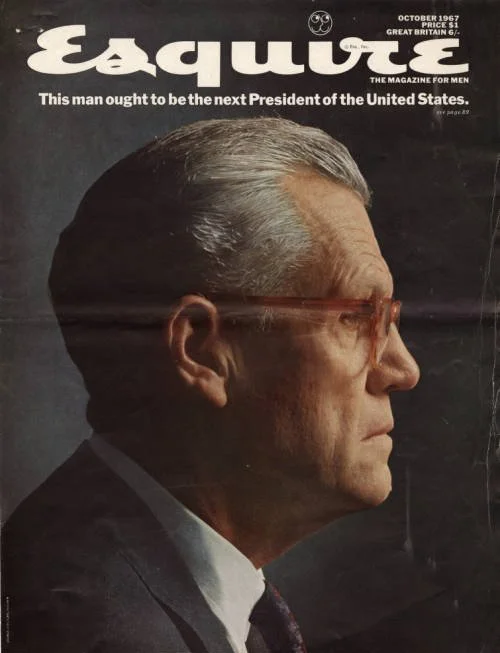
Image credit: Indiana Historical Society. J. Irwin Miller began to gain national recognition, both for his success in business and for his courage and leadership at the National Council of Churches. In 1967, unbeknownst to Miller, Esquire declared that he had the best résumé and was just the leader the United States needed to run for president in 1968. Read the article, “A Man for All Reasons,” published October 1, 1967.
What do we mean by Quality of Place?
In May 1994, Miller spoke at a preview of the Pritzker Architecture Prize Exhibition in Columbus. He tried to explain why the work had mattered.
“If I had to guess, I would guess that everyone in this room tonight wants to live in a 'good' community, not a 'lousy' one. Each of us would, of course, have his or her own definition of a 'good' community and would give different weights to different aspects of it, to the visible and the invisible.”
He named specifics. Public schools every parent would want their child to attend. Streets safe to walk day and night. Meaningful work for every young person. A city that had put behind it the corroding tensions of race, sex, and nationality. Then he said the thing this organization is built on:
“No one here would call any community a 'good' community unless it looked like a good community.”
Quality of place is the visible evidence of whether a community keeps its promises to all its residents.
The physical environment is not neutral, and it is not decoration. A city with beautiful civic buildings and neglected school buildings tells the truth about a community. A downtown that functions well beside a neighborhood that does not tells the truth. Design makes civic systems visible.
Most communities have aspirations, rankings, and placemaking consultants. What they rarely have is a working definition of quality of place that civic actors built together, own collectively, and can use to evaluate decisions over time. Building that definition is the work.