
Communities across the country want better public places. What they rarely have is an account of how a place gets that way and stays that way. Columbus, Indiana has been building that account for more than eighty years, in public, on streets and buildings anyone can walk through. This page sets out what we have learned and what we believe transfers.
Design excellence is a civic practice sustained by institutions, habits, and shared expectations about the quality of public life. Columbus has lived this practice for more than eighty years. It demonstrates that disciplined decisions about the built environment shape a community's civic identity, public trust, and long-term prosperity.
The field has plenty of language for what good places look like and almost none for how they come to be. Online community rankings measure economic outcomes. Placemaking practice measures activity in place. Neither tells a community whether the decisions it makes today will pay off in the future.
Two assumptions challenge success for communities: The first is that design excellence follows money, so a community without wealth should not expect it. The second is that it follows talent, so a community should hire a great architect and the rest will follow.
The Columbus story contradicts both. What Columbus has held on to across generations is a process, which has made good decisions likely and repeatable.
Communities often invest in place with no way to tell what is working. That gap is what this work addresses and it will take many partners to get right.
The Story of Columbus
Columbus is a city of fifty thousand people in south-central Indiana. It holds more than sixty projects of international design distinction. Work by Eero Saarinen, I.M. Pei, Harry Weese, Kevin Roche, Eliel Saarinen, Deborah Berke, and Michael Van Valkenburgh stands alongside schools, libraries, churches, parks, and civic buildings designed with the same care.
None of this happened because Columbus was wealthy, cosmopolitan, or unusually positioned for cultural investment. It happened because a civic leader and the Cummins Engine Company, now Cummins Inc., made a specific offer to support design excellence, a community accepted it, and both held to it across generations.
J. Irwin Miller was chairman and chief executive of Cummins Inc. Beginning in 1954, he offered to use the company’s profits to pay the architect's fees for any public building in Columbus on one condition: the architect must be chosen from a list assembled by a jury of design professionals. The offer has been running ever since and has extended to schools, churches, libraries, and civic buildings throughout Bartholomew County.
The condition is the whole point. Miller did not choose the architects. He built a process that made good choices likely and repeatable, and then he funded it long enough for the habit to outlast him. It continues today with five projects funded since 2018.
Columbus is the record. The Indiana Quality of Place Partnership is the public test.
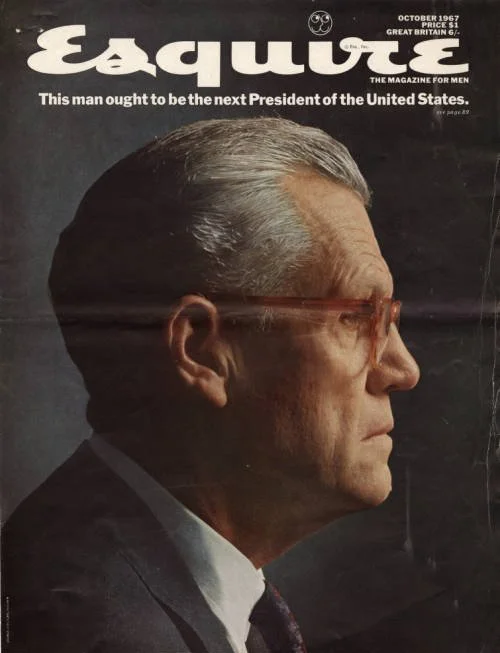
Image credit: Indiana Historical Society. J. Irwin Miller began to gain national recognition, both for his success in business and for his courage and leadership at the National Council of Churches. In 1967, unbeknownst to Miller, Esquire declared that he had the best resume and was just the leader the United States needed to run for President in 1968. Read the article, “A Man for All Reasons” published October 1, 1967.
✩ What we mean by quality of place
In May 1994, Miller spoke at a preview of the Pritzker Architecture Prize Exhibition in Columbus. He tried to explain why the work had mattered.
“If I had to guess, I would guess that everyone in this room tonight wants to live in a 'good' community, not a 'lousy' one. Each of us would, of course, have his or her own definition of a 'good' community and would give different weights to different aspects of it, to the visible and the invisible.”
He named specifics. Public schools every parent would want their child to attend. Streets safe to walk day and night. Meaningful work for every young person. A city that had put behind it the corroding tensions of race, sex, and nationality. Then he said the thing this organization is built on:
“No one here would call any community a 'good' community unless it looked like a good community.”
Quality of place is the visible evidence of whether a community keeps its promises to all its citizens.
The physical environment is not neutral, and it is not decoration. A city with beautiful civic buildings and neglected school buildings tells the truth about a community. A downtown that functions well beside a neighborhood that does not tells the truth. Design makes civic systems visible.
Most communities have aspirations, rankings, and placemaking consultants. What they rarely have is a working definition of quality of place that civic actors built together, own collectively, and can use to evaluate decisions over time. Building that definition is the work. It cannot be delivered from Columbus.
❈ The Civic Conditions
Columbus's strongest outcomes did not come from isolated projects or charismatic individuals. They came from the civic environment: the habits, institutions, and shared expectations that shape how a community decides its future.
We call these the Civic Conditions. They are prerequisites, not outcomes. They determine whether better outcomes are possible. They are interdependent, and the order is deliberate. Institutional strength makes trust possible. Trust allows shared meaning to emerge. Meaning shapes daily life. Together they generate the long-term value that sustains a community worth committing to.
A community that relies on particular leaders to sustain its standards has not built a civic culture. It has built a dependency.
We do not own these conditions. No single organization can. We work to name them, measure them, and strengthen them, in Columbus and with communities willing to ask honestly what it takes.
✺ Condition
Civic Stewardship and Institutional Capacity
✦ What it produces
Durable institutions and leadership norms that support disciplined decision-making and continuity across generations.
✱ Condition
Community Connection and Public Trust
✱ What it produces
People understand and trust how decisions about their built environment are made, leading to broader participation and shared ownership.
✱ Condition
Cultural Identity and Shared Meaning
✱ What it produces
Cultural heritage is publicly accessible, widely valued, and continually reinterpreted, so identity evolves without losing rigor.
✺ Condition
Everyday Public Life and Belonging
✦ What it produces
Public spaces and cultural resources are reliably functional, dignified, and welcoming.
✱ Condition
Long-Term Civic and Economic Value
✱ What it produces
Public and private investment reflects long-term civic value, even when it costs more up front and takes longer.
✱ Condition
Communities Worthy of Commitment
✱ What it produces
People choose places whose civic life and public realm demonstrate seriousness, fairness, and long-term care.
-
Columbus is evidence that this works. The method transfers; the particulars do not.
A model implies replication: take these elements, apply them elsewhere, expect similar results. Columbus's specific conditions are not transferable. Its history, institutions, philanthropy, and civic culture are products of a particular place and time.
What transfers is the method. The habits. The standards. The accountability to long-term public value. The discipline of deciding with rigor and care. Any community can build those. Columbus shows that they hold.
What Columbus learns from other cities matters as much as what it shares. A method that works only in Columbus is not a method. It is a local habit.
-
Design excellence is the practice of making decisions about the built environment with rigor, care, and accountability to the long-term public good, so that the places people share are worthy of their use, their trust, and their attachment.
It is civic because it belongs to everyone. Most of the built environment is shared, and decisions about it affect all residents, not only those with the resources to avoid the consequences.
It is a practice because it must be exercised repeatedly, across many decisions, by many people, over long periods. No single building establishes a community standard.
It is a discipline because it requires judgment. It requires reading a place carefully, understanding its history and its future, weighing competing values, and deciding for the whole rather than the few. That capacity can be taught, practiced, shared, and improved.
And because it is a discipline, it can be measured, and we believe measurement belongs inside the practice. It shows communities whether their decisions are producing the conditions they intend.
-
It is not a matter of taste. It is not a preference for a style, era, or aesthetic. It is not what happens when enough people agree that something is beautiful. It is not a luxury reserved for wealthy communities, and it is not the exclusive domain of professional designers.
-
The argument for design excellence is cultural. It is also economic, and Indiana's numbers are specific.
The 2024 report Embracing a Culture of Creativity: Indiana's Overlooked Economic Engine, commissioned by the Central Indiana Corporate Partnership, found that arts and cultural industries make up 2.0 percent of Indiana's gross state product, ranking the state 47th nationally. States with the highest concentrations of arts and culture in their economies pay workers across all industries nearly $22,000 more per year on average.
Indiana's per capita income stood at over 96 percent of the national average in the 1960s. It has fallen to 88 percent. The report argues that investment in arts, culture, and creativity can help close that gap.
The relationship runs in a cycle. Quality of place attracts talent. Talent generates economic activity. Economic activity funds civic institutions. Those investments sustain quality of place. Communities that break the cycle by disinvesting in public space rarely get it back easily.
-
In October 2026 we convene Prove It: A National Summit on Design Excellence as Civic Practice, with five Indiana cities and a national design faculty. The Prove It Summit requires Columbus to defend its claims in public, alongside practitioners who have done comparable work under different conditions.
Read about the Learning Partnership →
Exhibit Columbus is where we test this in our own city. Over ten years, it has commissioned new work from designers at every stage of their careers, placed it on public streets, and asked residents to live with it and argue about it. Most of the installations come down in three months, but some stay for years. The expectations they raise do not. Learning to measure that difference is the work.
-
Civic Design Institute: Defines the discipline and shares the method.
Progressive Preservation: Cares for design excellence over time.
Exhibit Columbus: Tests design excellence in public.
Monumental Gestures: Applies the method in Indianapolis.